Handwritten in Saffron: The Pastry Dynasties of Damascus Who Refused the Chains
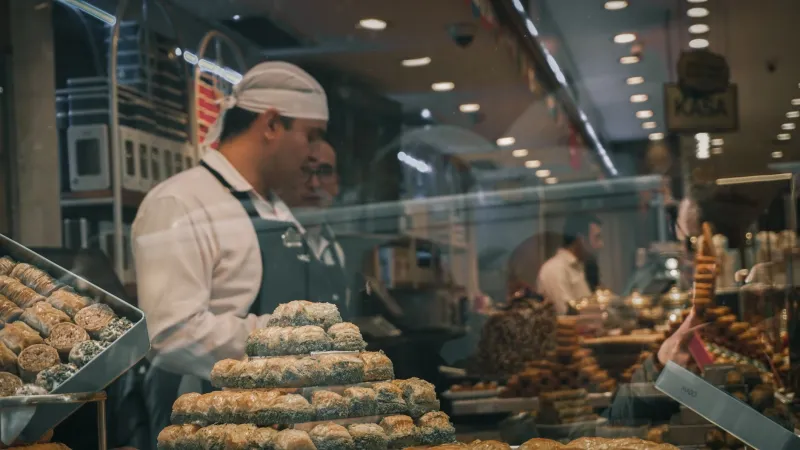
There is a particular kind of offer that arrives in Damascus each season, carried by representatives of international hospitality groups: a generous check, a long-term licensing agreement, and the promise that a family's baklava could be served in lobbies from Dallas to Dubai. And there is a particular kind of answer that keeps coming back — polite, firm, and final.
For the American traveler accustomed to finding the same croissant in every airport, this refusal is more than a curiosity. It is the reason a plate of pistachio pastry in a Damascus courtyard tastes like nowhere else on earth, and why the city's most discerning visitors now plan entire itineraries around a single shopfront.
A Ledger Older Than the Hotel
In a narrow lane off Souq al-Hamidiyah, a third-generation confectioner keeps his grandfather's recipe book wrapped in cloth behind the counter. The pages are stained with rosewater and dated in a hand that predates the automobile. When asked whether he would consider selling the formulas to a chain, he laughed before the question had even finished.
"They want the recipe," he said, folding a sheet of phyllo thin enough to read through. "But the recipe is not the paper. The paper is the weather, my hands, my uncle's oven, the way we listen to the dough. What would they buy?"
It is a distinction that American executives, trained to treat intellectual property as inventory, have struggled to close. Several multigenerational pastry houses in the old city have reportedly turned down expansion deals worth more than their shops will earn in a decade. None will say so on the record. All will confirm it over coffee.
What the Chains Cannot Replicate
The economics of refusal are easier to understand after an afternoon in one of these kitchens. Baklava here is not assembled; it is negotiated. The dough rests according to humidity, not a timer. The syrup cools to a specific patience rather than a specific temperature. A single master — the usta — tastes, adjusts, and judges, and his palate is not transferable to a franchise in Houston.
This is precisely why the luxury traveler has taken notice. The modern American tourist, having exhausted the interchangeable amenities of global five-star brands, is increasingly chasing what the industry calls the inimitable — experiences that cannot be licensed, shipped, or standardized. Damascus, perhaps more than any city reentering the luxury conversation, is rich in exactly that.
The Guest Who Asks the Right Questions
Concierges at the city's finer addresses report a shift in what American guests request. A decade ago, it was airport transfers and business centers. Today it is introductions — to the weaver, the attar master, and increasingly the confectioner whose family has filled the same brass trays since the 1920s.
The most requested visit is not a tasting but a watching. Travelers want to stand at the marble counter and see the phyllo stretched, the nuts scored into diamonds, the saffron syrup poured in slow threads. They want to hear the story of the grandfather who invented a particular fold, and the grandmother who refused to write down the final step so that it could only be learned by hand.
One guest from Chicago described it as the most memorable hour of a three-week journey: "I've eaten baklava my whole life. I had never once thought about who was allowed to know how it's made."
Luxury as a Matter of Scarcity
There is a lesson here for the broader hospitality world, and the city's hotels have absorbed it rather than fought it. Rather than attempting to bring the pastry families in-house, the smartest properties have done the opposite: they direct guests out the door, down the lane, to the source. The concierge who says "you must meet them yourself" is offering something no franchise agreement can produce — provenance as a service.
For the families, the calculus is simpler. A shop that sells to a chain sells its name once. A shop that keeps its recipes sells its story every day, to a steadily growing queue of travelers who flew across an ocean for a taste they cannot get at home.
Bringing Nothing Back but the Memory
American customs regulations being what they are, most visitors cannot carry the pastry home anyway. The confectioners consider this a feature, not a flaw. What leaves Damascus instead is the understanding — that some things of value are held, not sold; that a recipe guarded across four generations is a form of wealth no contract can price.
The offers from the chains will keep arriving, as they always have. And the answer, folded into the same polite refusal as the phyllo into its hundred layers, will keep coming back the same: some tables are simply not for sale.